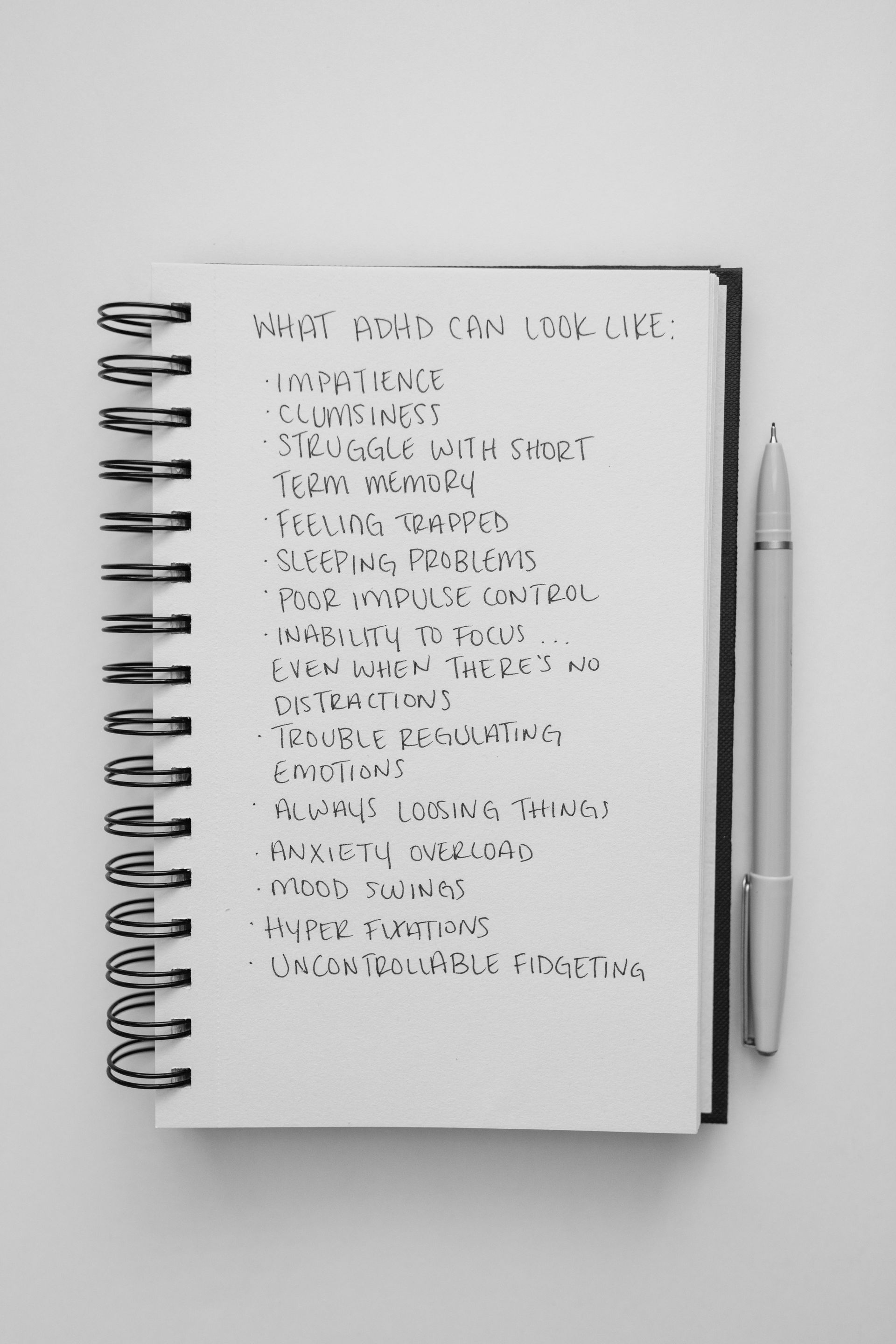
ADHD Hyperfocus: The Double-Edged Superpower You Didn't Know You Had
Here is the paradox that every person with ADHD knows intimately, even if they have never had the words for it. The same brain that cannot get through a ten-minute task it finds boring can lock onto something interesting for six hours straight, losing track of time, hunger, and every other obligation that was supposed to happen that day. The same mind that seems scattered and unfocused in one context becomes laser-precise and unstoppable in another. That is ADHD hyperfocus, and it is one of the most misunderstood, most underestimated, and most genuinely powerful features of the ADHD brain.
For a lot of people with ADHD, hyperfocus comes loaded with complicated feelings. There is the guilt of the things that did not get done while you were deep in the zone. The friction with people who felt invisible while your attention was somewhere else entirely. The disorientation of coming up for air hours later and realizing you have no idea where the time went. And underneath all of that, sometimes, a quiet suspicion that what just happened was actually kind of remarkable.
That suspicion is worth taking seriously. ADHD hyperfocus is not just a quirk to manage. It is a feature of your neurological wiring that, understood correctly and channeled intentionally, can become one of your most significant strengths. In case you are new here, we are Jeffrey and Rebekah. We built Healing Harmony to be the kind of place where your neurology is understood from the inside out. You can learn more about how we work on our ADHD therapy page.
What is hyperfocus in ADHD?
ADHD hyperfocus is a state of intense, sustained, and deeply absorbed attention directed at a single activity or subject. During hyperfocus, the outside world effectively disappears. Distractions that would normally derail attention become invisible. Time stops feeling linear. The usual friction of getting started, staying on task, and following through, all of which are genuinely hard for the ADHD brain under normal conditions, evaporates completely. What replaces it is a quality of engagement that feels almost effortless, even as it is consuming enormous cognitive resources.
This might sound like the opposite of ADHD. And in a way, it is, which is exactly what makes it so confusing, both for the person experiencing it and for the people around them. If someone with ADHD can focus for six hours on a video game or a creative project, the reasoning goes, then surely they could focus just as well on their homework or their taxes if they really wanted to. That reasoning is wrong, and understanding why it is wrong is one of the most important shifts in perspective a person with ADHD can make about their own brain.
Is hyperfocus a symptom of ADHD or a separate phenomenon?
Hyperfocus is not listed as an official diagnostic criterion for ADHD in the DSM-5, which has led to some clinical confusion about how to categorize it. But anyone who works closely with ADHD clients, or who has an ADHD brain themselves, will tell you that hyperfocus is as real and as characteristic of the ADHD experience as inattention or impulsivity. It is better understood not as a separate phenomenon but as the other face of the same underlying dysregulation.
ADHD is not fundamentally a deficit of attention. It is a deficit of attention regulation. The ADHD brain does not struggle to pay attention, it struggles to direct attention intentionally and consistently. When something captures the brain's interest intensely enough, the regulatory systems that normally distribute and redirect attention get bypassed, and the brain locks in with a focus that is actually more intense than what most neurotypical people can access. The problem is not the capacity for attention. It is the inability to control where that capacity goes.
What is happening neurologically?
At the neurological level, hyperfocus is closely tied to dopamine. The ADHD brain has a dysregulated dopamine system, it produces and receives dopamine differently than a neurotypical brain, which is why activities that offer immediate reward, novelty, interest, or challenge are so much more engaging than those that do not. When an activity hits the right combination of those triggers, the dopamine system responds strongly, and the brain's attention network locks in with an intensity that feels involuntary, because in a very real sense, it is.
This is why you cannot simply will yourself into hyperfocus on something boring, no matter how important it is. And it is why hyperfocus tends to attach itself to things that are genuinely interesting, personally meaningful, or high-stakes in a way the brain finds compelling. Understanding this removes a significant layer of shame from the experience, because it means hyperfocus is not selfishness or avoidance. It is neurology.
How long does ADHD hyperfocus last?
The duration of ADHD hyperfocus varies enormously. It can last anywhere from a couple of hours to an entire day, depending on the activity, the person, and the neurological conditions at the time. What most people with ADHD notice is that hyperfocus does not end gradually, it tends to end abruptly, either because an external interruption breaks the state or because the brain's engagement with the activity suddenly drops. When hyperfocus ends, it often leaves a feeling of disorientation, fatigue, and sometimes a low-grade crash as the dopamine surge recedes.
Is ADHD hyperfocus a good thing?
When hyperfocus attaches itself to the right thing at the right time, it can produce results that are genuinely extraordinary. When it attaches itself to the wrong thing at the wrong time, it can derail an entire day, week, or relationship in ways that are genuinely costly. The goal is not to eliminate hyperfocus, that is neither possible nor desirable. The goal is to understand it well enough to create conditions where it is more likely to work for you than against you.
What is the difference between ADHD hyperfocus and a flow state?
Flow state, the concept popularized by psychologist Mihaly Csikszentmihalyi, refers to a state of optimal engagement where the challenge of a task perfectly matches the person's skill level, producing deep absorption, effortless performance, and intrinsic reward. ADHD hyperfocus shares some features with flow, the absorption, the loss of time, the sense of effortless engagement, but it differs in important ways. Flow tends to be more voluntary and more aligned with skill-building. Hyperfocus can attach to activities that are not productive, not growth-oriented, and not chosen deliberately. It can happen whether you want it to or not.
Can ADHD hyperfocus actually be used as a superpower?
Yes, and we say this not as a motivational platitude but as a clinical and lived reality. Some of the most creative, productive, and innovative people in any field have ADHD brains that hyperfocus with extraordinary intensity on the things they care about most. The depth of engagement that hyperfocus produces, the ability to go further into a subject, a problem, or a creative project than most people can sustain, is genuinely rare and genuinely valuable.
How does hyperfocus connect to ADHD burnout?
Hyperfocus and ADHD burnout are more closely linked than most people realize. The hyperfocus boom-and-bust cycle, periods of intense, high-output engagement followed by crashes of depletion and inability to function, is one of the primary drivers of ADHD burnout, particularly in young adults who have not yet learned to manage the cycle. During a hyperfocus episode, the brain is consuming neurological resources at a high rate. When the episode ends, those resources need to be replenished, and if they are not, the cumulative depletion builds toward burnout.
Recognizing the hyperfocus-burnout connection is an important part of sustainable ADHD management. It means building in genuine recovery time after high-focus periods rather than trying to maintain the same output level through the crash.
Your brain is not broken, it is extraordinary in ways you are still learning to use
Understanding your hyperfocus, what triggers it, how it moves through your system, what it costs you and what it gives you, is not just practically useful. It is a form of self-knowledge that changes how you see yourself. And changing how you see yourself is often where the most important work begins.
If you are ready to stop managing your hyperfocus as a problem and start understanding it as part of what makes you genuinely capable, we would love to work with you. We offer online ADHD therapy across Texas and in-person therapy in Dallas. Reach out today, and bring your whole brain with you.

*AI Disclosure: This content may contain sections generated with AI with the purpose of providing you with condensed helpful and relevant content, however all personal opinions are 100% human made as well as the blog post structure, outline and key takeaways.
* Blog Disclaimer: Please note that reading our blog does not replace any mental health therapy or medical advice. Read our mental health blog disclaimer here.

Hello, we are Jeffrey & Rebekah
Therapists and life coaches at Healing Harmony. We specialize in supporting multicultural families and Third Culture Kids (TCKs) through transitions and emotional challenges, fostering resilience and cultural identity.

Download your FREE life journal